Over the Edge
by Rachel Federman
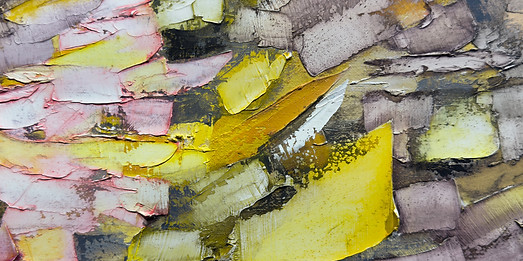
Lookout, detail, 2008, oil on linen, 38 x 42 inches
Two or three days into a week-long meditation retreat in 1977, Judith Murray was nearly overcome by a desire to “get a taxi.” But then, she says, “you go over the edge, and it is just pure joy.” Murray describes the experience of beginning a painting in similar terms. Starting is a challenge, but once she determines the size of the canvas, and the width of the vertical bar she invariably paints along its right edge, she enters a state of pleasure. “When I start focusing on a new work, that’s success,” she recently told an interviewer.[i] Earlier in her career, Murray was engaged with Zen Buddhism. A respected teacher once told her that if one has a propensity to be a monk, she should devote her life to Zen; but if one has a propensity for something else, she should devote her Zen life to that other thing. “And I knew I was a painter,” Murray says.[ii]
Like so many others artists of vision, Murray had her first solo exhibition with the legendary dealer Betty Parsons. Comprising not-quite-square paintings of crisp, eccentric shapes against velvety matte black grounds, the show took place in the spring of 1976 at Parsons-Truman, a gallery operated by Parsons and her longtime director, Jock Truman. In the venerable SoHo Weekly News, John Perreault began his review with a disquisition on the pitfalls of conformity and consensus in the art world. He went on to laud Murray for her originality, writing that her paintings “move me in some way and yet they do not fit into any of the accepted categories.” He warned against marginalizing her work, “simply because it is not all-over or color field.”[iii] Here, he cited dominant painting trends of the time. But painting was itself in retreat during that period, its relevance challenged by Conceptual Art and Post-Minimalism.
Artists in the Seventies were more likely to adopt new materials like resin or Plexiglas, or to embrace dematerialization or performance, than to pursue painting. In an era of irreverent experimentation, Murray’s work, though playful, was distinguished by an almost classical devotion to the medium of oil on linen. P.S. 1 founder Alanna Heiss remembers that Murray’s paintings were “formally stretched, and never hanging from the ceiling or propped up on garbage cans,” as other artists’ were. In 1978, Heiss gave Murray an exhibition at the Clocktower Gallery, one of the alternative spaces she ran under the aegis of the Institute for Art and Urban Resources. Viewers, Heiss recalls, were “surprised not to trip over Dennis Oppenheim’s dead dog,” or one of Gordon Matta-Clark’s architectural interventions.[iv]
When she arrived in New York as a teenager in 1958, Murray studied at Brooklyn’s Pratt Institute, where she came under the influence of the instructor Walter Murch. Even when Abstract Expressionism overtook the New York art world, Murch sustained his utterly original approach to still life. Working in oil on canvases that he subjected to wear-and-tear, he depicted mechanical objects with their casings removed, rendering them in an airless, encrusted style that heightened their metaphorical potentialities. Murray also counts Ad Reinhardt as a signal influence. She encountered his work after her arrival in New York, when she began to visit galleries for the first time. Like Murch, Reinhardt was represented by Parsons. Prompted in part by his engagement with Zen Buddhism, Reinhardt embraced a limited palette of red, blue, and black, before devoting himself almost exclusively to square black-on-black paintings of exquisite subtlety. Murray was a close friend of Robert Ryman, who single-mindedly pursued the infinite possibilities of white paint over the course of his sixty-year career.
Murray is part of this genealogy of stubborn nonconformists with a passion for paint and a yen for self-imposed limitations. Since the 1970s, she has used only four colors—red, yellow, white, and black—which she blends to achieve endless chromatic variation. Likewise, even as her style has evolved, she continues to use a near-square format, complicated by the presence of her signature vertical bar. Murray has been as protective of her singular approach to paintings as she has been of the space in which she makes them. Throughout her decades-long career, she has maintained her own studio, saying, “I thought it was very important, especially for a woman, to have her own place.”[v] Access to a dedicated space—so often denied to women artists—has enabled Murray to work at a large scale, similar to Abstract Expressionists such as Helen Frankenthaler and Lee Krasner, whose works she imbibed during her formative years.[vi] “I loved that they painted big with great confidence,” she says.[vii] Murray insists that “there’s nothing like looking at a big painting. There’s nothing like doing a big painting. It’s thrilling.” The experience of looking at Murray’s paintings is indeed thrilling.
In the mid-1980s, the hard edges of Murray’s forms began to dissolve, and her grounds gained in complexity, as if she had grown weary of holding the line between figure and ground. This change can be tracked through her extraordinary graphite drawings as well. Murray soon embarked on an all-over approach like the one that Perreault, writing in 1976, measured her against. But she has made it her own, developing a repertoire of marks, gestures, and massing that is as infinitely variable as her palette. In the last two decades, she has introduced a heightened sense of motion into her paintings, transforming her marks from nouns into emphatic verbs. There is an increased focus on tempo as well, with masses of tight, staccato marks weaving their way through, or tussling with, fields of loose, broad strokes. Sometimes, as in the monumental In the Midst (2025), the vertical bar acts like a ballast against this whirling motion. At other times, as in Threshold (2018), the bar flickers at the edge of perception, less a stabilizing boundary than an invitation to the beyond. Her paintings can feel evanescent, like the shimmering Euphoria (2025), or rooted, like Vibe (2025).
Murray treats oil paint as a three-dimensional material, imbuing her paintings with a tactile dimension that works in concert with the geology of her gestures and strokes. Before she even begins to apply layers of oil paint, she builds up a complex substrate of acrylic paint, which she reveals very rarely, and even then, only in glimpses. This underlayer—sensed, even if it is not seen—is a necessary aspect of Murray’s process. It allows her to play freely with her palette and composition, to enter into the painting. The moment when she “starts sculpting with the oil paint,” as she puts it, is the moment when there is “no going back. A total commitment. Actually the edge of the precipice.”[viii] Fortunately for her viewers, Murray takes them with her over the edge.

Installation shot of Pure Pleasure, May-June 2026
Rachel Federman, PhD, is an art historian and curator. She is currently writing a biography of Betty Parsons.
_____
Endnotes
[i] Judith Murray and Will Ryman, “In This Way: Interview,” in Judith Murray: Paradise Paradox (Hong Kong: CA Design, 2025), p. 14.
[ii] Judith Murray in conversation with the author, May 27, 2025.
[iii] John Perreault, “A Nonconformist Painter,” The SoHo Weekly News, June 3, 1976.
[iv] Alanna Heiss, “Introduction,” Judith Murray: Paradise Paradox (Hong Kong: CA Design, 2025), p. 7.
[v] Judith Murray and Robert Yasuda interviewed by Alanna Heiss, in Judith Murray and Robert Yasuda: Duo (Sundaram Tagore Galleries, 2014), p. 49.
[vi] Lee Krasner took over the barn in which Jackson Pollock made his paintings after his death in 1956. It was a marked improvement on the bedroom she had used previously.
[vii] Judith Murray, email to author, May 11, 2026.
[viii] Judith Murray and Robert Yasuda interviewed by Alanna Heiss, in Judith Murray and Robert Yasuda: Duo (Sundaram Tagore Galleries, 2014), p. 54.